
SES Water still has no hosepipe ban (checked 17 Sept) and is not on the EA's list of 10 firms with one. Thames Water's ban only covers its own customers.
Whether you can legally use a hosepipe in Epsom this week depends on which company sends your water bill, not on where the borough boundary runs.
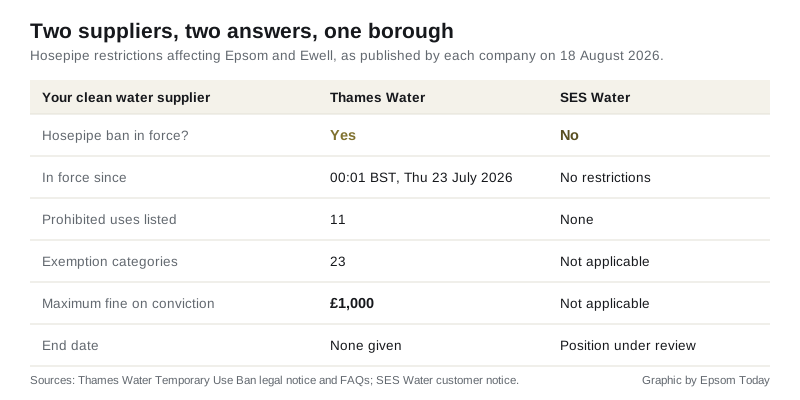
SES Water is telling customers it is not imposing a ban. A customer notice on its home page, first read on Tuesday 18 August and still word for word the same when we checked again on Thursday 17 September, reads: “SES Water are not planning to introduce a hosepipe ban at this stage, we continue to monitor the situation closely and will ensure that any changes be communicated to customers.”
Thames Water has taken the opposite decision. Its ban has now been in force for eight weeks, and breaking it is a criminal offence carrying a fine of up to £1,000.
SES Water hosepipe ban 2026: where it stands on 17 September
There is no SES Water hosepipe ban in 2026 so far. Two independent checks agree:
- SES Water’s own notice still says it is “not planning to introduce a hosepipe ban at this stage” and will tell customers of any change.
- The Environment Agency’s weekly drought report for 4 to 10 September 2026, published 11 September, lists every company with a temporary use ban. There are ten, covering 30 million people, including Thames Water across its whole area and South East Water across its whole area. SES Water is not on the list.
That does not mean the area is out of the woods. The same report lists both the Thames and Kent and South London Environment Agency areas as in drought, which between them take in south London and much of Surrey. On 16 September the government said almost three-quarters of England remains in drought and that 120% of typical rainfall is needed over the next seven months for every area to come out of it.
SES Water’s supply is 85% groundwater, which is topped up mainly by winter rain, so how wet this winter is will matter more to it than the last few weeks of September. Its rulebook for that decision is being rewritten now: the company consulted on its Draft Drought Plan 2027 from 21 May to 31 July 2026, including an appendix on what it learned from the 2025 drought, and says it will publish its response to the comments by 25 October 2026.
The Thames Water ban, and what it actually covers
Thames Water announced its Temporary Use Ban at 9.30am on Tuesday 21 July. Its legal notice says the prohibition started at 00:01 BST on Thursday 23 July 2026 and applies to the whole of the Thames Water supply area.
The notice lists 11 prohibited uses. They include:
- watering a garden, lawn or allotment with a hosepipe or sprinkler
- cleaning a vehicle or a leisure boat with a hosepipe
- filling or maintaining a swimming pool, paddling pool, pond or ornamental fountain
- cleaning walls, windows, paths, patios or artificial outdoor surfaces
Anyone who contravenes the prohibitions “may be guilty of an offence, and liable, on summary conviction, to a fine not exceeding £1,000”.
There are 23 categories of exemption. Among them are uses needed for health and safety, watering food crops, customers on the Priority Services Register with specified conditions, people with impaired mobility, newly planted trees and shrubs for their first 28 days, and drip irrigation systems fitted with a timer.
The ban has no end date. Thames Water’s status page says only that restrictions “will be lifted as soon as conditions allow”, and its answer on how long it will last is that it depends on the weather and needs “prolonged and significant rainfall”. As of 17 September its status page still reads: “A hosepipe ban remains in place for customers supplied by Thames Water.” It says the ban has cut household demand in London by around 3% and water use across the Thames Valley and Home Counties by more than 6%, and that the dry weather has it repairing more than 1,000 leaks a week, around 20% more than normal.
The line that matters for Epsom
Buried in Thames Water’s own frequently asked questions is the sentence that decides this for a large number of local households:
The Thames Water hosepipe ban does not apply to customers who only receive wastewater services from Thames Water.
That is the position many people in the borough are in. Thames Water can be the company that takes your sewage away while a different company supplies the drinking water coming out of the tap. The ban attaches to the clean water supply, so a Thames Water sewerage bill on its own does not put you under it.
SES Water describes its own patch as 322 square miles supplying 160 million litres a day to more than 750,000 people in parts of Surrey, Kent and south London, “extending from Morden and South Croydon in the north to Gatwick Airport in the south and from Cobham, Leatherhead and Dorking in the west to Edenbridge in the east”. Epsom and Ewell sits inside that description.
We are not going to tell you which company supplies your particular street, because the boundary does not follow the borough and getting it wrong would be the difference between a legal hosepipe and a £1,000 fine. Thames Water sends customers to Water UK’s find your supplier tool for exactly this reason, and its own guidance notes that “water use restrictions may vary between water companies”.
The quickest check is your most recent water bill. The company named on it for water supply, as opposed to wastewater, is the one whose rules you are under.
Why the two companies reached different answers
Thames Water’s reasoning is set out in its announcement. It cited the driest spring in years, three official heatwaves and record temperatures, with the region receiving only 40% of average rainfall and no rainfall at all in the Thames catchment in the first part of July. It said demand was running around 10% above normal across the Thames Valley and Home Counties and 7% above normal in London, an extra 100 million litres a day. It also said it repairs more than 750 leaks a week, and that it produced over 20 billion litres of drinking water between 3 and 10 July.
SES Water draws on different sources. It says 85% of its supply comes from groundwater, with the rest from the River Eden feeding its reservoir at Bough Beech. On the same page it says it “has proudly not had to instigate any hose pipe or water restrictions during summer months in over a decade”, while acknowledging that the South East is classed as “seriously water stressed”.
Groundwater responds to rainfall more slowly than a river-fed reservoir does. That is the practical reason two neighbouring suppliers can look at the same hot summer and reach different conclusions.
What the borough’s MP has said
Epsom and Ewell’s MP has put her position on Thames Water on the parliamentary record. In the Commons on 16 June 2026, in a debate on Thames Water, Helen Maguire said the company “is sinking under £20 billion of debt”, that her constituents were “on average, paying an additional £203 a year”, and asked when the Government would “put Thames Water into special administration”.
She has also raised the water companies’ role in the planning system. In a Commons debate on flooding on 13 May 2025 she said she had met Thames Water and SES Water representatives, and argued that water companies should be made statutory rather than professional consultees on medium to large developments. Our Epsom planning news page tracks the applications that decision would affect.
What it means for you
Check the bill before you get the hosepipe out. The restriction follows your clean water supplier, not your postcode and not the council area.
If Thames Water supplies your drinking water:
- the ban is live now and has been since 23 July
- watering cans, buckets and water butts are all still allowed, and are not covered by the prohibitions
- if you think an exemption applies to you, check the legal notice rather than assuming, because the exemptions are specific and several are time limited
- if you are on the Priority Services Register, look at the conditions attached to that exemption
If SES Water supplies your drinking water:
- there is no ban at this stage, and the company has said it is monitoring the position
- that is a statement of current intent, not a guarantee, and with the region still in drought it is worth re-checking the SES home page before a heavy day of garden watering
Either way, both companies are asking people to use less. Thames Water says demand across the Thames Valley and Home Counties has been running about 10% above normal, an extra 100 million litres a day, and SES Water says it is monitoring conditions closely. Neither is treating the position as settled going into the autumn.
Sources
- Thames Water, Temporary Use Ban legal notice
- Thames Water, temporary hosepipe ban status page
- Thames Water, hosepipe ban FAQs
- Thames Water, Temporary Use Ban announcement, 21 July 2026
- SES Water, customer notice on its home page
- SES Water, about us
- SES Water, our water resources
- Hansard, Thames Water, 16 June 2026
- Environment Agency, Dry weather and drought in England: 4 to 10 September 2026
- Environment Agency and Defra, National Drought Group update, 16 September 2026
- SES Water, Draft Drought Plan public consultation
- Water UK, find your supplier
Have your say